
![Folate on a Plant-Based Diet: What the Doctors Say [2026]](https://makeitplantbased.com/images/articles/folate-plant-based-diet/folate-plant-based-diet-featured.webp)
Here is a fact most people find surprising: vegans and vegetarians consistently test higher in folate than meat-eaters. Not slightly higher — significantly higher. And yet the question “do I need a folate supplement on a plant-based diet?” keeps showing up in every nutrition forum, every WFPB Facebook group, and every first appointment with a new plant-based-curious doctor. The confusion is understandable, because folate and folic acid sound interchangeable but behave very differently in the body.
Folate is a B vitamin — vitamin B9 — and it is absolutely essential for DNA synthesis, cell division, and the production of healthy red blood cells. Its name comes from the Latin word folium, meaning leaf. That etymology is not a coincidence. Leafy greens, legumes, and other plant foods are where nature put folate, and where the human body learned to find it over millions of years of evolution. Folic acid, on the other hand, is the synthetic version — stable at room temperature, cheap to manufacture, and since 1998 mandatory in enriched flour products in the United States.
This article explains what the research actually shows about folate on a plant-based diet, what some of the most respected plant-based physicians say about food sources versus supplements, and what you specifically need to know if you are pregnant or planning to become pregnant. The short answer for most plant-based eaters is reassuring: if you are eating a varied whole-food plant-based diet rich in legumes and greens, you are almost certainly meeting your folate needs from food alone. But the details — especially around pregnancy, MTHFR gene variants, and the food-vs-supplement distinction — matter enormously.
What Is Folate?
Folate is a water-soluble B vitamin that the body cannot produce on its own — it must come from food or supplements. Its primary jobs in the body are remarkably fundamental: folate helps build DNA, supports cell division, and is essential for the production of red and white blood cells in bone marrow. Every time a cell divides, folate is required. This is why folate is so critical during periods of rapid cell growth — early pregnancy, infancy, adolescence — and why it remains important throughout life for maintaining healthy tissue turnover.
At a biochemical level, folate acts as a coenzyme in one-carbon transfer reactions — the molecular machinery behind DNA methylation and amino acid metabolism. It works hand-in-hand with vitamin B12: both vitamins are needed to convert homocysteine into methionine, and both are needed for healthy neurological function. When either is deficient, homocysteine accumulates in the blood — a condition associated with increased cardiovascular risk.
The word “folate” covers a family of related compounds found naturally in food, all of which the body converts to the active form: 5-methyltetrahydrofolate (5-MTHF). This conversion requires a functional MTHFR enzyme. Roughly 10–15% of the population carries MTHFR gene variants (most commonly C677T) that reduce the efficiency of this conversion — a relevant consideration when choosing between food folate, folic acid supplements, and methylfolate supplements.
The recommended daily intake (Dietary Folate Equivalents, or DFE) is 400 µg for adults, 600 µg during pregnancy, and 500 µg while breastfeeding. One cup of cooked lentils alone delivers close to 90% of the daily adult requirement. Most plant-based eaters reach 400 µg without even trying.
The Plant-Based Folate Advantage — Debunking the Myth
One of the most persistent myths about plant-based diets is that they risk nutritional deficiency across the board. Folate is actually the clearest example of the opposite being true. The concern about B12 supplementation on a plant-based diet is legitimate and well-documented — vegans absolutely need to supplement with B12. But folate is a completely different situation.
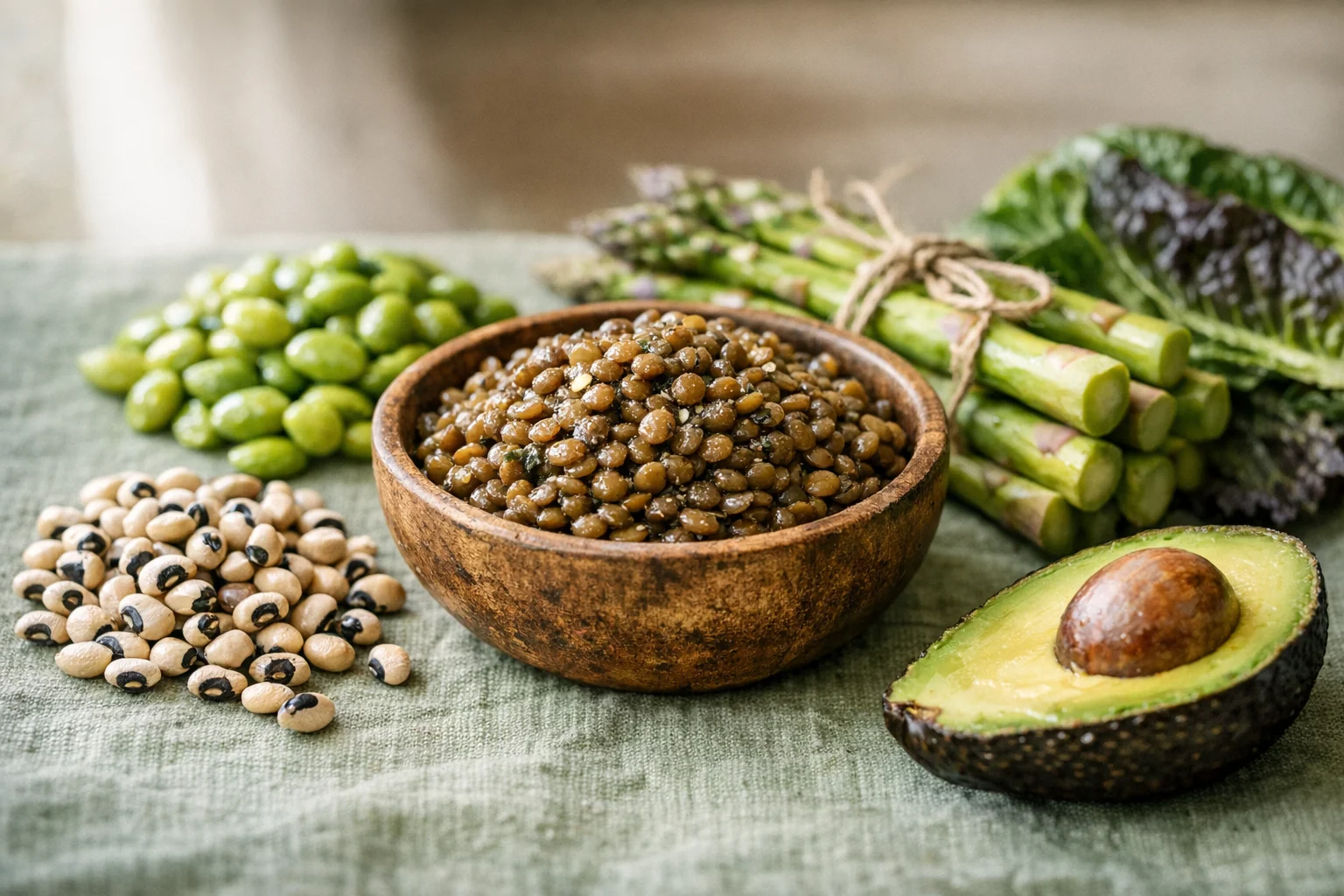
The richest food sources of folate on the planet are precisely the foods that plant-based eaters eat in abundance: dark leafy greens like spinach, kale, collards, and romaine; legumes like lentils, black beans, chickpeas, and edamame; asparagus, broccoli, Brussels sprouts, and avocado. A typical whole-food plant-based diet that includes a daily serving of legumes and dark greens easily clears 600–800 µg of dietary folate per day without any supplementation.
Compare this with a typical Western omnivore diet, where the primary folate sources are often fortified breakfast cereals and refined grains — a much less reliable, and far more synthetic, delivery mechanism. The food industry recognized this gap decades ago, which is why the US FDA mandated folic acid fortification of enriched grain products in 1998. But that fortification program was designed to protect a population eating few vegetables and legumes. Plant-based eaters are operating in an entirely different dietary context.
What the Research Shows
The scientific literature on folate and plant-based diets is remarkably consistent — and consistently reassuring for plant-based eaters, while also raising important nuances about forms of folate.
Plant-Based Eaters Are Higher in Folate
A comprehensive 2021 systematic review published in the journal Nutrients examined 141 studies comparing nutrient intake in plant-based versus meat-eating adults across Europe, Asia, and North America. The finding on folate was unambiguous: folate intake was higher in vegetarians and vegans compared to meat-eaters. While meat-eaters showed elevated risk for inadequate folate intake, plant-based eaters consistently exceeded recommendations from food alone. (PMID 35010904, Neufingerl & Eilander, 2021)
Adequate Folate Reduces Stroke Risk
A landmark 2016 meta-analysis from Harvard T.H. Chan School of Public Health — encompassing 30 randomized controlled trials with 82,334 participants — found that adequate folate status was associated with a 10% lower risk of stroke (relative risk 0.90, 95% CI 0.84–0.96) and a 4% lower risk of overall cardiovascular disease. Critically, the protective effect was greatest in people who started with the lowest plasma folate levels, suggesting that dietary folate adequacy — the situation most plant-based eaters are already in — provides the most meaningful protection. (PMID 27528407, Li et al., Journal of the American Heart Association, 2016)
Dietary Folate and Cancer Protection
A 2024 systematic review and dose-response meta-analysis published in Heliyon pooled data from 18 prospective cohort studies involving 931,469 participants and 14,860 colorectal cancer cases. The findings were dose-dependent: each additional 100 µg of dietary folate per day was associated with a 3% lower risk of colorectal cancer (RR 0.97, 95% CI 0.95–0.99), with an even stronger effect for colon cancer specifically (7% lower risk per 100 µg). Protective effects were observed up to 500 µg daily of dietary folate. The study found inverse associations most pronounced in high-risk subgroups including smokers and alcohol drinkers. (PMID 39071590, Khalighi Sikaroudi et al., 2024)
Homocysteine and Cardiovascular Risk
Folate and vitamin B12 work together to metabolize homocysteine. When dietary folate is sufficient — again, the typical state for plant-based eaters consuming legumes and greens — homocysteine levels tend to stay in a healthy range. When folate is inadequate, homocysteine accumulates and becomes a marker for elevated cardiovascular risk. This is one biochemical reason why the folate-rich plant-based diet may confer cardiovascular protection across multiple studies.
What Plant-Based Physicians Say About Folate
Some of the most trusted voices in plant-based medicine have addressed the folate question directly — and the consensus is consistent: eat your beans and greens, be cautious with high-dose folic acid supplements, and follow specific guidelines if you are pregnant or planning to be.
Dr. Michael Greger — Food Folate Is Not the Same Thing as Folic Acid
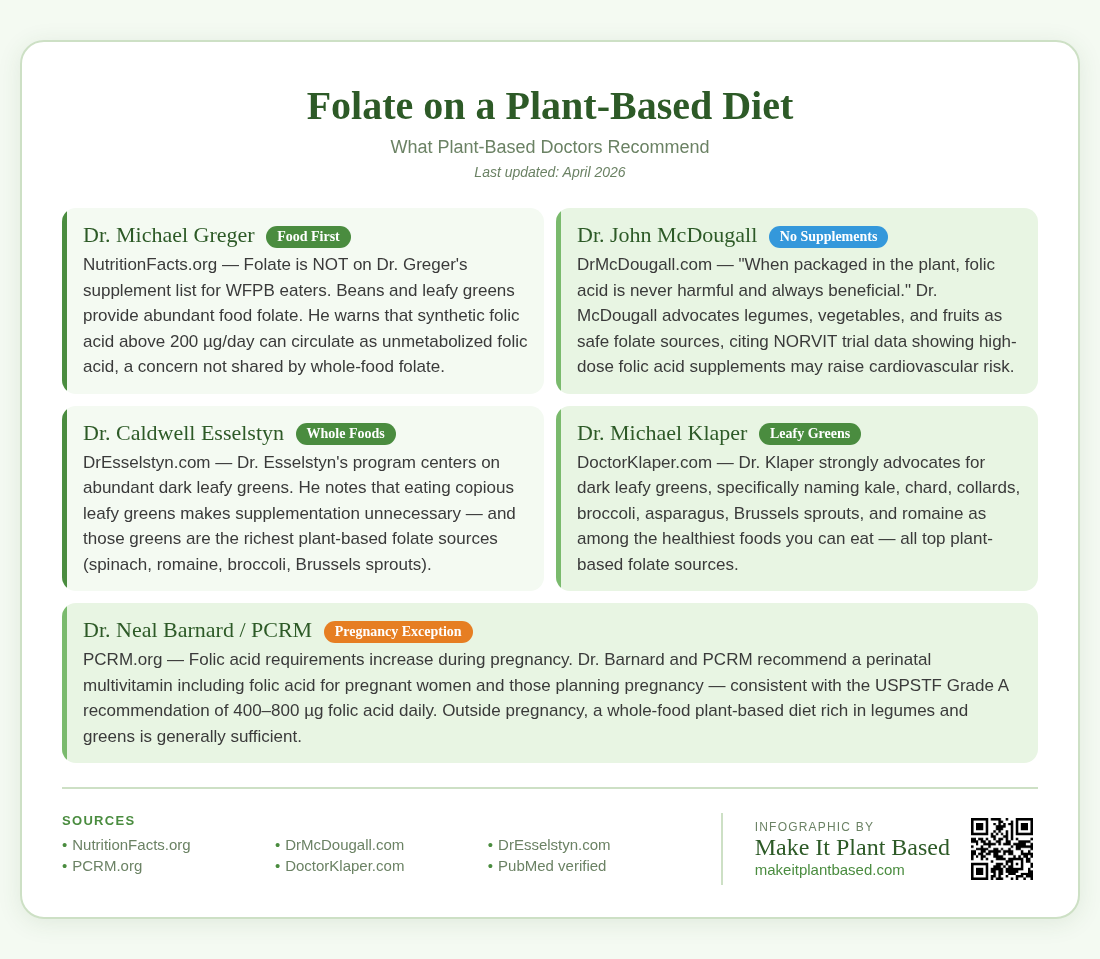
Dr. Michael Greger of NutritionFacts.org has produced detailed content on the distinction between food-based folate and synthetic folic acid — a distinction he considers clinically important. On his Optimum Nutrient Recommendations page, folate does not appear on his list of supplements recommended for plant-based eaters. B12, vitamin D, omega-3s, iodine, selenium, and calcium are on the list — but not folate. For plant-based eaters eating a diet rich in beans and greens, Greger views food-based folate as naturally sufficient.
Greger does draw a sharp line, however, between food folate and folic acid supplements at high doses. His review of the research found that consuming more than 200 µg of folic acid per day — the amount found in many standard multivitamins — can result in unmetabolized folic acid (UMFA) circulating in the bloodstream. UMFA has been associated in some studies with decreased natural killer (NK) cell immune function, and randomized controlled trials have found increased cancer risk at higher folic acid doses. He continues to recommend that women of reproductive age take folic acid specifically for neural tube defect prevention — that benefit is established and significant — but notes the distinction between the pregnancy-specific recommendation and general supplementation.
The practical take from Greger: for most plant-based adults, no folate supplement is needed. Eat your lentils, eat your greens, and let food do what it has always done.
Dr. John McDougall — “When Packaged in the Plant, Folic Acid Is Never Harmful”
The late Dr. John McDougall addressed the folate question with characteristic directness in a detailed article on his website titled “Folic Acid Supplements Are a Health Hazard.” His message was unambiguous: food folate is always safe, synthetic folic acid supplements are not.
“Folic acid is a synthetic version of the natural vitamin, folate, found in plant foods. Folate from food is essential for good health. Folic acid sold in capsules is a medication at best and a toxin at worst.” McDougall pointed to the NORVIT trial — a large randomized study of 3,749 cardiac patients followed for 3.5 years — which found that supplementing with as little as 0.8 mg/day of folic acid was associated with a 20% increase in heart attack, stroke, and death risk, along with a 30% increase in cancer risk.
His recommendation was direct: direct efforts toward eating more legumes, vegetables, and fruits — what he called “the plentiful and safe sources of folic acid.” As he wrote: “When packaged in the plant, folic acid is never harmful and always beneficial.” He also noted the etymology that links these foods to the vitamin itself: “The name folic comes from the word foliage, which refers to plants.”
On the question of where to get folate: legumes, leafy vegetables, and fruits. Not pills.
Dr. Caldwell Esselstyn — Leafy Greens as the Foundation
Dr. Caldwell Esselstyn, whose program reversed advanced heart disease in clinical settings, built his approach around one central pillar: copious quantities of dark leafy green vegetables, eaten daily. On his FAQ page, he states plainly that “if eating copious amounts of leafy green vegetables, a multi vitamin is unnecessary” — and recommends only B12 and vitamin D as supplements.
While Dr. Esselstyn does not specifically address folate by name, the implication is clear: his daily prescription of large quantities of kale, collards, chard, spinach, arugula, and other dark greens provides a dense and reliable source of food folate. A single cup of cooked spinach delivers over 260 µg of folate — two-thirds of the adult daily requirement in one serving. Esselstyn’s patients eating his protocol are almost certainly meeting folate needs several times over, from food alone.
Dr. Neal Barnard / PCRM — Increased Needs During Pregnancy
The Physicians Committee for Responsible Medicine, led by Dr. Neal Barnard, addresses folate specifically in its pregnancy guidance. Their plant-based pregnancy resource notes that “folic acid requirements increase” during pregnancy and recommends a perinatal multivitamin — particularly to ensure adequate folic acid during the critical early weeks of neural tube development. This context is important: the supplementation recommendation from PCRM is specifically tied to the pregnancy window, where the stakes (neural tube defects) are high and the reliable standardized dose of folic acid provides a meaningful safety margin.
Outside of pregnancy, PCRM’s dietary guidance consistently emphasizes beans, peas, and dark leafy vegetables as the cornerstone of plant-based nutrition — all of which are naturally rich in folate.
Dr. Michael Klaper — The Case for Eating Your Greens
Dr. Michael Klaper, a longtime plant-based physician and educator, makes his position on leafy greens emphatic. His “Why Greens?” article opens with a call to action: “EAT WAY MORE DARK LEAFY GREEN VEGETABLES!” He names the specific vegetables he considers most valuable: kale, chard, collards, broccoli, asparagus, Brussels sprouts, and romaine lettuce — and describes them as “arguably among the healthiest foods you can eat.”
Every single vegetable on Klaper’s recommended list is a top-tier source of dietary folate. The message from the food side is consistent: dark leafy greens eaten abundantly every day provide a nutrient profile that is difficult to replicate with supplementation — and folate is one of the key reasons why.
Signs of Folate Deficiency
While deficiency is uncommon among committed whole-food plant-based eaters, it is worth knowing what to watch for — especially during periods of increased need (pregnancy, illness, certain medications) or if your vegetable and legume intake has dropped.
Megaloblastic anemia is the hallmark of folate deficiency. In this condition, red blood cells become abnormally large but functionally impaired — they cannot carry oxygen efficiently, leading to fatigue, shortness of breath, and pallor. This presentation is similar to B12-deficiency anemia, which is why it is important to test both B12 and folate levels if deficiency is suspected. Treating one deficiency while the other goes unaddressed can mask symptoms and allow neurological damage from B12 deficiency to progress.
Other signs that may indicate folate insufficiency include persistent fatigue and weakness, mouth sores or a swollen, smooth tongue (glossitis), irritability and difficulty concentrating, and elevated homocysteine levels on a blood test. If your homocysteine is high, both folate and vitamin B12 status should be evaluated, as both are needed to metabolize homocysteine effectively.
Certain medications can also deplete or interfere with folate absorption, including methotrexate (used for arthritis and some cancers), sulfasalazine, and some anticonvulsants. If you take any of these, discuss your folate status with your healthcare provider.
How to Get Enough Folate on a Plant-Based Diet
For most plant-based eaters, reaching the 400 µg daily target — or even double that — requires nothing more than eating the foods already at the center of a whole-food plant-based diet. Here is a practical guide to the highest-folate plant foods and how to build them into your daily meals.
Top Plant-Based Folate Sources
Source: USDA FoodData Central. DFE = Dietary Folate Equivalents. % DV based on 400 µg daily recommendation for adults.
Practical Tips for Maximizing Folate from Food
Make legumes a daily staple. A cup of lentil soup, a bean burrito, a bowl of edamame, or a serving of hummus with vegetables gets you most of the way to your daily folate target in a single meal. If you use our DRI Calculator, you will see that a legume-plus-greens meal pattern clears 400 µg of folate with ease.
Prioritize dark leafy greens at every meal. Spinach in your smoothie, kale in your stir-fry, collard wraps instead of tortillas, romaine as the base of your salad — these are easy daily habits that consistently deliver folate alongside dozens of other protective phytonutrients and iron.
Cook gently to preserve folate. Folate is water-soluble and heat-sensitive. Boiling vegetables can destroy 50–70% of their folate content. Steaming, roasting, or lightly sautéing preserves more. When you do boil, consider using the cooking water in soups or sauces to recover some of the water-soluble nutrients.
Pair folate-rich foods with vitamin C. Vitamin C enhances iron absorption and may also help stabilize folate bioavailability. A squeeze of lemon on your lentil soup or salad is a simple habit worth building in.
Eat varied, not monotonous. Rotating between different leafy greens and different legumes ensures you get the full spectrum of folate alongside complementary nutrients. The gut microbiome also benefits from dietary diversity — and a diverse microbiome fed with plenty of fiber actually synthesizes some folate of its own, particularly species like Bifidobacterium.
Use our Ingredient Nutrient Lookup tool to check the folate content of any specific food before you buy or cook it.

Folate vs. Folic Acid: Why the Form Matters
This distinction trips up even well-informed people, so it is worth understanding clearly.
Food folate occurs naturally in plant foods as a complex of polyglutamate forms. When you eat a serving of spinach or lentils, your digestive system breaks these polyglutamates down into monoglutamates, absorbs them across the gut wall, and converts them to the active 5-MTHF form. This is a multi-step process with built-in regulation — the body takes what it needs and limits absorption at higher intakes. Food folate at any realistic dietary amount has never been shown to cause harm.
Folic acid is the synthetic, oxidized form of folate. It is far more stable (which is why it works well in fortified foods), and at doses under 200 µg, it is efficiently converted to active folate in the gut before entering the bloodstream. However, at higher doses — the amounts found in many prenatal vitamins, stand-alone folate supplements, and heavily fortified foods — the conversion capacity of the gut is overwhelmed. Unconverted folic acid enters the bloodstream as UMFA (unmetabolized folic acid).
UMFA is not benign. Research cited by Dr. Greger and others has linked circulating UMFA to reduced natural killer (NK) cell activity and, in some randomized trials, to increased cancer risk at high doses. The NORVIT trial, as McDougall highlighted, found that 0.8 mg/day of folic acid was associated with a 20% increase in cardiovascular events in cardiac patients — the opposite of what was expected.
The MTHFR Consideration
About 10–15% of the population carries the MTHFR C677T genetic variant, which reduces the efficiency of the enzyme that converts folic acid and food folate to the active 5-MTHF form. People with this variant may have difficulty processing large amounts of folic acid specifically. If you know you carry MTHFR variants and want to supplement, many practitioners recommend methylfolate (already in active form) rather than folic acid. However, from food alone — including abundant plant-based folate from leafy greens and legumes — this distinction is largely moot. Food folate is already partially pre-converted and does not depend as heavily on MTHFR efficiency.
The practical summary: food folate = always safe and sufficient for most. Folic acid supplements at low dose (400 µg, as found in a standard B-complex) are generally fine. High-dose folic acid supplements (>800 µg, especially as standalone supplements) warrant caution except where specifically recommended — as in early pregnancy.
Pregnancy: The One Exception Where Folic Acid Supplementation Is Non-Negotiable
Everything above applies to healthy plant-based adults who are not pregnant. Pregnancy is a different category, and the science and medical consensus here are clear.
Neural tube defects (NTDs) — conditions including spina bifida and anencephaly — occur during the first 28 days of pregnancy, often before a woman knows she is pregnant. NTDs are caused by failure of the neural tube to close properly, and adequate folate/folic acid is the single most important preventive factor. In the United States, approximately 3,000 pregnancies are affected by NTDs each year, despite folic acid fortification of grain products since 1998.
In 2023, the US Preventive Services Task Force (USPSTF) reaffirmed its Grade A recommendation — its highest rating — that all persons planning to or who could become pregnant take a daily supplement containing 0.4 to 0.8 mg (400 to 800 µg) of folic acid, starting at least one month before conception and continuing through the first trimester. (PMID 37526713, JAMA, 2023)
Why folic acid rather than food folate during this window? Because the dose needs to be reliable, standardized, and predictable. While food-based folate is ideal for general nutrition, it varies with cooking method, storage, and gut absorption. The standardized folic acid supplement dose has been validated in clinical trials to reduce NTD risk by 50–70% when taken before conception. This is one context where all plant-based physicians — including those who are generally skeptical of supplements — agree: take the folic acid supplement.
For plant-based pregnant women: continue eating your legumes and dark leafy greens throughout pregnancy, as the choline and other nutrients they provide are also essential for fetal development — and add a prenatal supplement that includes 400–800 µg of folic acid (or methylfolate if you have MTHFR variants). Your provider can advise on specific formulations.
Frequently Asked Questions About Folate on a Plant-Based Diet
Do plant-based eaters get enough folate?
Yes — in most cases, plant-based eaters get significantly more folate than meat-eaters. A 2021 systematic review of 141 studies found that vegetarians and vegans consistently had higher folate intake than omnivores. Legumes and dark leafy greens — the foundations of a whole-food plant-based diet — are the richest dietary sources of folate. A single cup of cooked lentils delivers 90% of the adult daily requirement.
Should I take a folate supplement on a plant-based diet?
For most healthy plant-based adults eating a varied diet with legumes and leafy greens, folate supplementation is not necessary. Dr. Greger’s recommended supplement protocol for plant-based eaters does not include folate — only B12, vitamin D, omega-3s, iodine, selenium, and calcium. If you are pregnant or planning to become pregnant, you should take a folic acid supplement (400–800 µg daily) regardless of diet quality — this is a USPSTF Grade A recommendation.
What is the difference between folate and folic acid?
Folate is the natural form found in food — particularly in plant foods like leafy greens and legumes. Folic acid is the synthetic form used in supplements and food fortification. At low doses (under 200 µg), folic acid is efficiently converted to active folate in the gut. At higher doses, the conversion system is overwhelmed and unmetabolized folic acid (UMFA) can accumulate in the bloodstream — a state that some research has linked to immune and cancer-related concerns. Food folate at any realistic dietary intake has no such concern.
Which plant foods are highest in folate?
The richest plant-based sources are edamame (482 µg per cup), black-eyed peas (358 µg per cup), lentils (358 µg per cup), asparagus (268 µg per cup), cooked spinach (263 µg per cup), black beans (256 µg per cup), broccoli (168 µg per cup), Brussels sprouts (156 µg per cup), avocado (163 µg per whole avocado), and romaine lettuce (128 µg per 2 cups raw). Including one serving of legumes and one serving of dark leafy greens daily typically covers the full adult daily requirement of 400 µg.
Does folate help prevent cancer?
Research suggests that adequate dietary folate intake is associated with lower colorectal cancer risk. A 2024 meta-analysis of 18 cohort studies with nearly one million participants found that each 100 µg increase in daily dietary folate was linked to a 3% reduction in colorectal cancer risk and a 7% reduction in colon cancer risk specifically. The protective effect appears dose-dependent up to approximately 500 µg daily. Note that this research is about food-based dietary folate — high-dose folic acid supplements do not appear to carry the same benefit and may carry additional risks at high doses.
What happens if you have a folate deficiency?
Folate deficiency can cause megaloblastic anemia — a condition where red blood cells become abnormally large and cannot carry oxygen efficiently. Symptoms include fatigue, weakness, shortness of breath, mouth sores, and a swollen smooth tongue (glossitis). Folate deficiency also raises homocysteine levels, which is associated with increased cardiovascular risk. Because the symptoms overlap with B12 deficiency, both should be tested if deficiency is suspected. Deficiency is uncommon in whole-food plant-based eaters who regularly consume legumes and dark leafy greens.
Take the guesswork out of plant-based nutrition.
Explore our evidence-based guides on the nutrients that matter most.
Browse All Nutrient Guides