
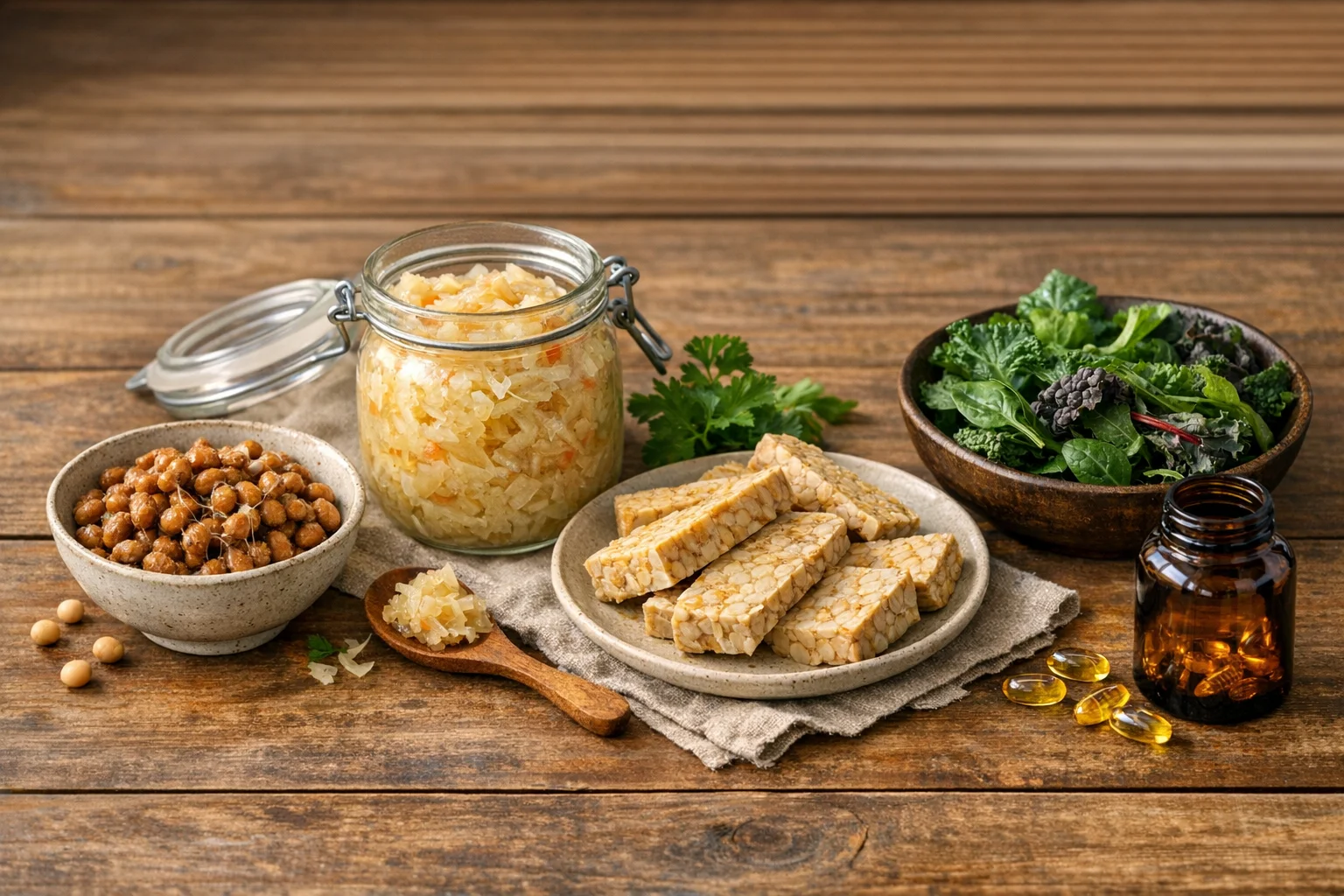
When you hear “vitamin K,” you likely think of leafy greens—but there’s a lesser-known form, K2, that’s gaining serious attention in nutritional science for its role in bone health on a plant-based diet and cardiovascular and blood sugar health protection. While K1 (found in kale, spinach, collards) is essential for blood clotting, K2 activates proteins that direct calcium on a plant-based diet to your bones and prevent arterial calcification. For plant-based eaters, K2 presents key questions: Can gut bacteria convert K1 into K2? Can fermented foods like natto provide meaningful amounts? And should you supplement?
This article covers K2 science, explores what plant-based doctors actually recommend (spoiler: they disagree), and shows you how to optimize K2 intake—whether through food or supplements.
What Is Vitamin K2? Understanding the K1 vs K2 Distinction
Vitamin K is a family of compounds with different roles in the body. K1 (phylloquinone), found abundantly in dark leafy greens, is essential for blood clotting with an established RDA of 90 μg daily for women and 120 μg for men. K2 (menaquinone), produced primarily by bacteria in fermented foods and your gut, activates proteins that direct calcium to bones and prevent arterial calcification. Unlike K1, which is synthesized by plants, K2 is bacterial in origin—a fundamental distinction that explains why animal products like cheese contain K2 from bacterial fermentation in their production, and why fermented plant foods are equally valuable sources.
The pathway from K1 to K2 involves bacterial conversion in the human gut and fermented foods. K1 from leafy greens (spinach, kale, collards) can be converted to K2 by intestinal bacteria, particularly *Bacteroides* species, though this conversion is inherently inefficient—typically only 5-10% of dietary K1 converts to K2 even under optimal conditions. This inefficiency is why fermented foods become crucial for plant-based K2 adequacy. Bacteria in fermented plant foods—particularly *Bacillus subtilis* in natto and *Lactobacillus* species in sauerkraut and tempeh—produce K2 directly, providing bioavailable K2 without relying on gut conversion.
Within K2, multiple forms exist, but the two most researched are MK-4 and MK-7, distinguished by their menaquinone chain length. MK-4 (also called menaquinone-4) is produced in animal tissues from K1 conversion and is abundant in egg yolk and animal products—it has a short half-life of approximately 1 hour, requiring multiple daily doses if supplemented. MK-7 (menaquinone-7), found abundantly in fermented plant foods like natto, has a dramatically longer half-life of approximately 72 hours, staying in your bloodstream three days compared to MK-4’s single hour. This difference is load-bearing for supplementation strategy: MK-7 requires only once-daily dosing while MK-4 needs multiple times daily to maintain therapeutic levels. For plant-based eaters, MK-7 from natto or MK-7 supplements is therefore the practical choice, with better bioavailability and more convenient dosing.
How K2 Works in Your Body
K2’s mechanism of action centers on two critical proteins: osteocalcin in bone and Matrix Gla Protein (MGP) in blood vessels. K2 (as the cofactor for vitamin K-dependent gamma-carboxylase) carboxylates osteocalcin, a bone protein produced by osteoblasts (bone-building cells). This carboxylation activates osteocalcin, enabling it to bind calcium and anchor it into the mineral matrix of bone—a process essential for bone mineralization and strength. Without adequate K2, osteocalcin remains uncarboxylated (inactive), and calcium mobilized by vitamin D on a plant-based diet3 cannot be efficiently incorporated into bone despite high intake. This explains why high-calcium, high-D3 intakes don’t guarantee strong bones—K2 is the missing piece that makes the system work.
Simultaneously, K2 carboxylates Matrix Gla Protein (MGP), a locally acting anticoagulant in arterial walls. MGP prevents vascular calcification—the pathological process where calcium deposits in artery walls, stiffening vessels and increasing cardiovascular risk. This dual action creates what researchers call the “calcium paradox”: without adequate K2, consuming high calcium and high D3 can paradoxically strengthen bones while stiffening arteries. K2 solves this by carboxylating both osteocalcin (directing calcium to bone) and MGP (preventing calcium from entering arteries). Think of K2 as the “conductor” that orchestrates where calcium goes in your body.
The Animal Product Myth: Debunking the K2 Restriction
The widespread myth that K2 is exclusively an animal product crumbles when you examine fermented plant foods, particularly natto (fermented soybeans), which contains one of the highest concentrations of K2 of any food on Earth. Natto provides approximately 775 μg of K2 (in the highly bioavailable MK-7 form) per 100 grams. To contextualize this extraordinary amount: a single 50-gram serving of natto delivers roughly 387 μg of K2—meeting many people’s entire daily K2 needs in one food. This amount is comparable to consuming an entire wheel of aged cheddar cheese (which provides roughly 50 μg per 100g), making natto not just adequate but superior.
The comparison to animal products is illuminating. While some aged cheeses contain 50-76 μg of K2 per 100g, and grass-fed beef or organ meats may provide 5-30 μg per 100g (depending on the animal’s diet), natto’s 775 μg per 100g makes it roughly 10-15 times more concentrated in K2 than most animal products. This isn’t incidental—the K2 in cheese comes from bacterial fermentation during cheese production, and the K2 in beef comes from bacterial fermentation in the cow’s rumen. Plant-based fermentation is biochemically equivalent, producing identical MK-7 through the same bacterial species (*Bacillus subtilis*).
Why the persistent misconception? K2 was identified relatively recently in nutritional science (gaining prominence only in the past 15 years), and most early research focused on animal products before fermented plant foods were thoroughly investigated. Additionally, the K2 content of foods varies dramatically based on bacterial culture and fermentation conditions—a batch of sauerkraut fermented for 2 weeks contains more K2 than one fermented for 3 days—making plant food K2 content seem less predictable than it actually is.
Other fermented plant foods contribute K2 in meaningful amounts when combined over time: a half-cup serving of traditionally fermented sauerkraut (unpasteurized, from the refrigerated section) provides approximately 5-10 μg of K2, fermented tempeh yields 2-3 μg per serving, kimchi contributes 1-2 μg, and miso paste may provide 1-5 μg depending on fermentation duration and culture used. These amounts don’t reach natto’s level but compound meaningfully across multiple meals—eating fermented foods twice daily could yield 15-30 μg from these sources alone, supplementing natto intake or supplementation.
Research & Statistics on K2: The Emerging Science
The Rotterdam Study, a landmark Dutch longitudinal study tracking over 4,800 postmenopausal women (average age 72) for a median of 8 years, stands as one of the most rigorous datasets on K2 and cardiovascular health. Researchers measured dietary K2 intake at baseline using food frequency questionnaires and followed participants for incident cardiovascular events and mortality. The findings were striking: women in the highest quartile of K2 intake (averaging 32.7 μg daily) had a 57% reduction in coronary heart disease mortality compared to those in the lowest quartile (averaging 8.5 μg daily)—a protective effect that remained statistically significant even after adjusting for K1 intake, total vitamin K, calcium, and other confounders. This independence from K1 intake is crucial: it demonstrates K2’s distinct protective role beyond the blood-clotting functions of K1, suggesting K2 specifically protects arterial tissue through MGP activation and vascular calcification prevention.
The mechanism behind this protection involves arterial calcification prevention. Arterial calcification (when calcium deposits in artery walls) is a hallmark of cardiovascular aging and occurs through two pathways: inflammation-driven deposition and passive calcium precipitation. K2-mediated MGP carboxylation prevents both by locally inhibiting calcification. In autopsy studies, researchers found that calcified arteries from individuals with low K2 status contained calcium deposits in the media (muscular wall) of arteries, increasing stiffness and restricting blood flow. In contrast, arteries from those with adequate K2 status showed minimal calcification even when calcium intake was high. This distinction is load-bearing: it demonstrates that K2 isn’t about reducing calcium intake but about directing calcium appropriately.
For bone health, prospective cohort studies and randomized controlled trials consistently demonstrate that K2 supplementation (particularly MK-7) is associated with improved bone mineral density and reduced fracture risk. A meta-analysis of MK-7 supplementation trials found that supplementation at 90-180 μg daily improved lumbar spine bone mineral density by 1-2% annually compared to placebo, a modest but clinically meaningful effect over time. When combined with vitamin D3 (which increases calcium absorption) and adequate calcium intake (targeting 1,000-1,200 mg daily), the protective effects compound: D3 mobilizes calcium, K2 directs it to bone via osteocalcin carboxylation, and calcium becomes the mineral substrate. All three working synergistically demonstrate superior fracture prevention compared to any single nutrient alone.
Research also shows high K2 intake is independently associated with lower arterial stiffness (measured by pulse wave velocity), a key marker of vascular aging and cardiovascular disease risk. A 2009 study in the American Journal of Clinical Nutrition found that individuals with K2 intake above the 75th percentile had significantly lower arterial stiffness compared to those below the 25th percentile—suggesting K2’s protective effects extend beyond bone mineralization to vascular health across the lifespan.
Currently, there is no official RDA for K2, which reflects the nutrient’s relative newness in nutritional science and the field’s ongoing investigation of optimal intake. However, research suggests optimal intake ranges from 90 to 180 μg daily of MK-7, with some evidence supporting intakes as high as 180-200 μg for maximum bone and cardiovascular protection. Studies testing higher doses (up to 1,080 μg daily) found no adverse effects, as K2 is not stored in the body but excreted in excess—making it one of the safest nutrients to supplement at higher levels if indicated by individual risk factors.

What Plant-Based Doctors Recommend: Where Expert Opinion Divides
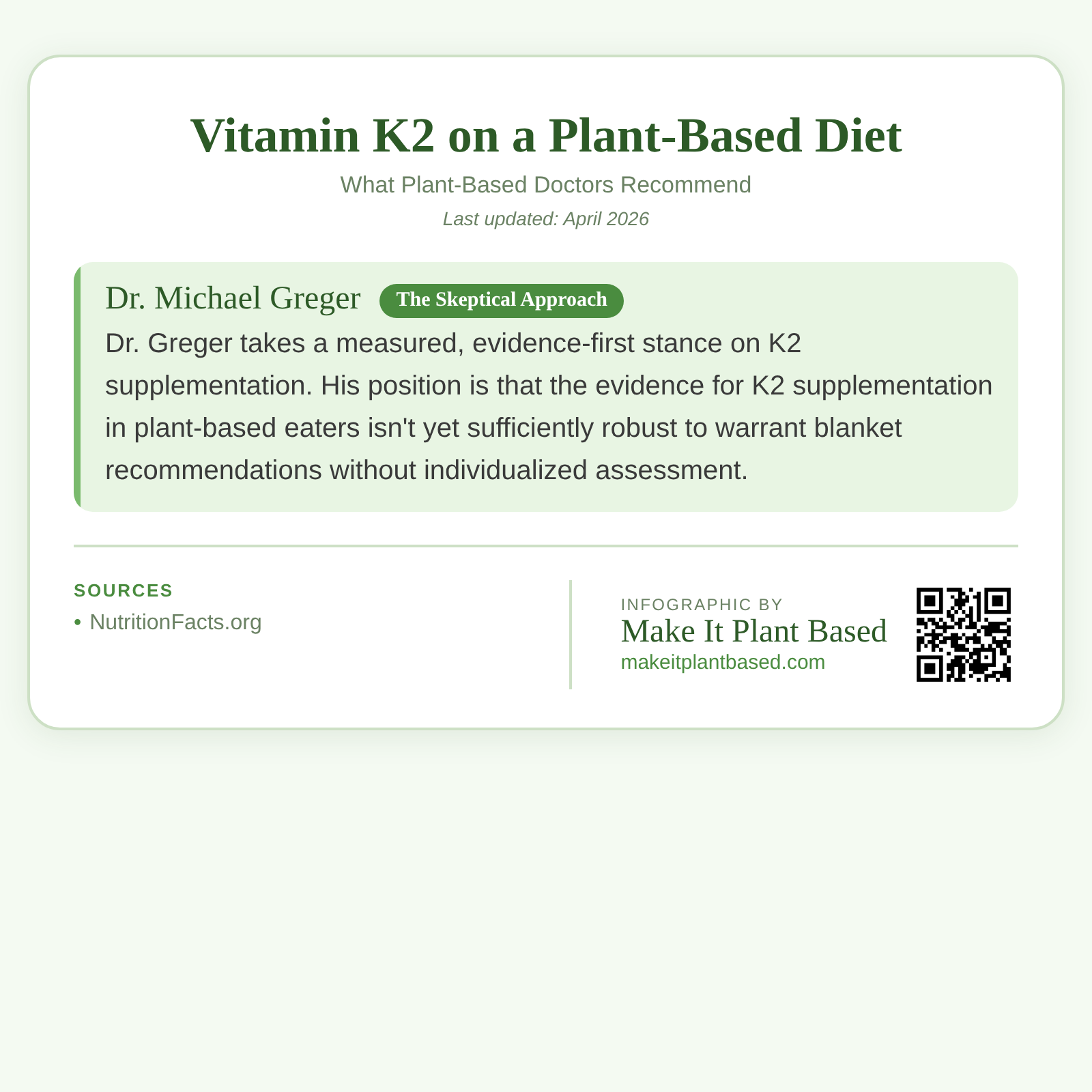
When it comes to K2, plant-based doctors don’t present a unified front. This disagreement, far from being a weakness, actually strengthens the credibility of the nutritional conversation: it reflects genuine scientific debate about a nutrient that’s still being understood.
Dr. Michael Greger — The Skeptical Approach
K1 to K2 Conversion: Can Your Gut Do the Job?
One of the most intriguing aspects of K2 biology is that your gut bacteria can theoretically synthesize K2 directly from K1, the abundant form in greens. Your colonic microbiota, particularly *Bacteroides fragilis* and other anaerobic species, produce menaquinones (K2) as part of their normal metabolism when K1 substrate is available. This conversion pathway suggests that a plant-based eater consuming plenty of kale, spinach, and collards might achieve adequate K2 without external fermented food sources or supplements. However, the practical reality is far more complex. Efficiency varies dramatically between individuals and depends critically on specific bacterial taxa, their abundance, and their metabolic state.
Multiple factors significantly impair K1-to-K2 conversion. Dysbiosis (bacterial imbalance favoring pathogenic species), antibiotic use (which devastates beneficial bacteria for months even after a single course), digestive issues like IBS or Crohn’s disease, insufficient fiber intake (which starves beneficial bacteria), and excessive alcohol consumption all reduce conversion capacity. Studies suggest that even under optimal conditions—pristine gut health, abundant fiber, K1-rich diet—only 5-10% of dietary K1 converts to K2, making the pathway an important supplement to fermented food sources rather than a reliable sole source. Additionally, conversion occurs in the colon, and produced K2 has limited absorption window since menaquinones are produced distally from the primary site of K2 absorption in the small intestine.
Best Plant-Based K2 Sources: The Complete Guide
Natto: The Plant-Based K2 Powerhouse
Natto, fermented soybeans from Japan, is the richest plant-based K2 source. This traditional food derives its exceptional K2 content from *Bacillus subtilis*, the beneficial bacterium responsible for fermentation. A 50-gram serving (roughly 3 tablespoons) delivers approximately 387 μg of K2—meeting many people’s entire daily needs in one food. The challenge: natto has an acquired taste. The texture is slimy, the aroma is pungent, and the flavor is strongly umami with fermented notes. If trying natto for the first time, approach it strategically: start with small amounts mixed into warm rice, which masks the texture. Sushi restaurants often have natto rolls, providing a gentler introduction. Eating 2-3 weekly servings covers weekly K2 needs. Look for naturally fermented varieties like Marukame Natto with minimal ingredients (just soybeans and salt).
Use the Vitamin K in Plant Foods ranking tool to find dietary K sources, or the Daily Nutrient Needs Calculator to find your full vitamin K target.
Other Fermented Plant Foods
While natto stands alone in K2 abundance, fermented plant foods contribute K2 meaningfully over time. A half-cup serving of sauerkraut provides roughly 5-10 μg of K2, tempeh offers 2-3 μg, kimchi contributes 1-2 μg, and miso paste may provide 1-5 μg depending on fermentation duration. These amounts compound: eating fermented foods at multiple meals throughout the week builds up your K2 intake. The key criterion is purchasing raw, unpasteurized versions from the refrigerated section—heat-processed versions available in supermarkets don’t contain K2. These foods also provide probiotics and digestive support beyond K2 content.
K1-Rich Foods as K2 Precursors
Dark leafy greens provide K1 substrate for gut bacterial conversion. Eating 2-3 servings daily of kale, spinach, collards, or chard maximizes conversion probability. Combined with fermented foods and good gut health, this may provide sufficient K2 without supplements.
K2 Supplements: Navigating Options and Dosage Strategy
If food sources don’t appeal to you, are unavailable, or you want explicit assurance of consistent K2 intake, supplementation provides a direct and evidence-supported solution. When should you supplement versus relying on food sources? Consider supplementation warranted if: (1) you cannot tolerate or access natto regularly, (2) you have digestive issues affecting conversion (dysbiosis, recent antibiotics, IBS, IBD), (3) you’re over 50 with family history of bone loss or cardiovascular disease, (4) you have low vitamin D3 levels, or (5) you want explicit certainty of K2 status. In contrast, adequate K2 from food may suffice if you consume natto 2-3 times weekly, eat abundant greens daily, have pristine gut health, and take D3 supplementation.
Choose MK-7 over MK-4 for supplementation due to superior half-life (72 hours vs. 1 hour), allowing once-daily dosing rather than multiple times daily—a practical advantage that improves compliance. Research on optimal dosage suggests that 90 μg daily of MK-7 provides measurable bone health benefits and arterial protection, with meta-analyses showing measurable improvements in bone mineral density at this dose. However, dosage recommendations vary by individual risk profile: general adult maintenance dosing is 90 μg daily, but higher doses (180 μg daily) may be prudent for those over 50, with family history of osteoporosis or cardiovascular disease, with existing low bone density (T-score below -1.0), or with multiple cardiovascular risk factors. Studies testing doses up to 1,080 μg daily in human subjects found no adverse effects, making K2 one of the safest nutrients to supplement at higher levels when indicated.
Look for supplements providing MK-7 (not MK-4) at 90-180 μg daily. Many plant-based K2 supplements intelligently combine K2 with D3 (algae or lichen-derived) and sometimes calcium, addressing the synergistic nutritional pairing discussed in the section below. Third-party tested brands (verified by NSF International, USP, or ConsumerLab) provide assurance of label accuracy and absence of contaminants. If you’re vegan or allergic-sensitive, verify that supplements use algae or fermentation-derived K2 (nattokinase-derived) rather than any animal sources. Combination D3+K2 supplements are generally superior to taking them separately since they ensure you take both synergistic nutrients together with food for optimal fat-soluble absorption. Take all K2 supplements with a fat-containing meal (nuts, seeds, olive oil, avocado) to maximize absorption, as K2 is fat-soluble and requires dietary lipids for effective intestinal uptake.
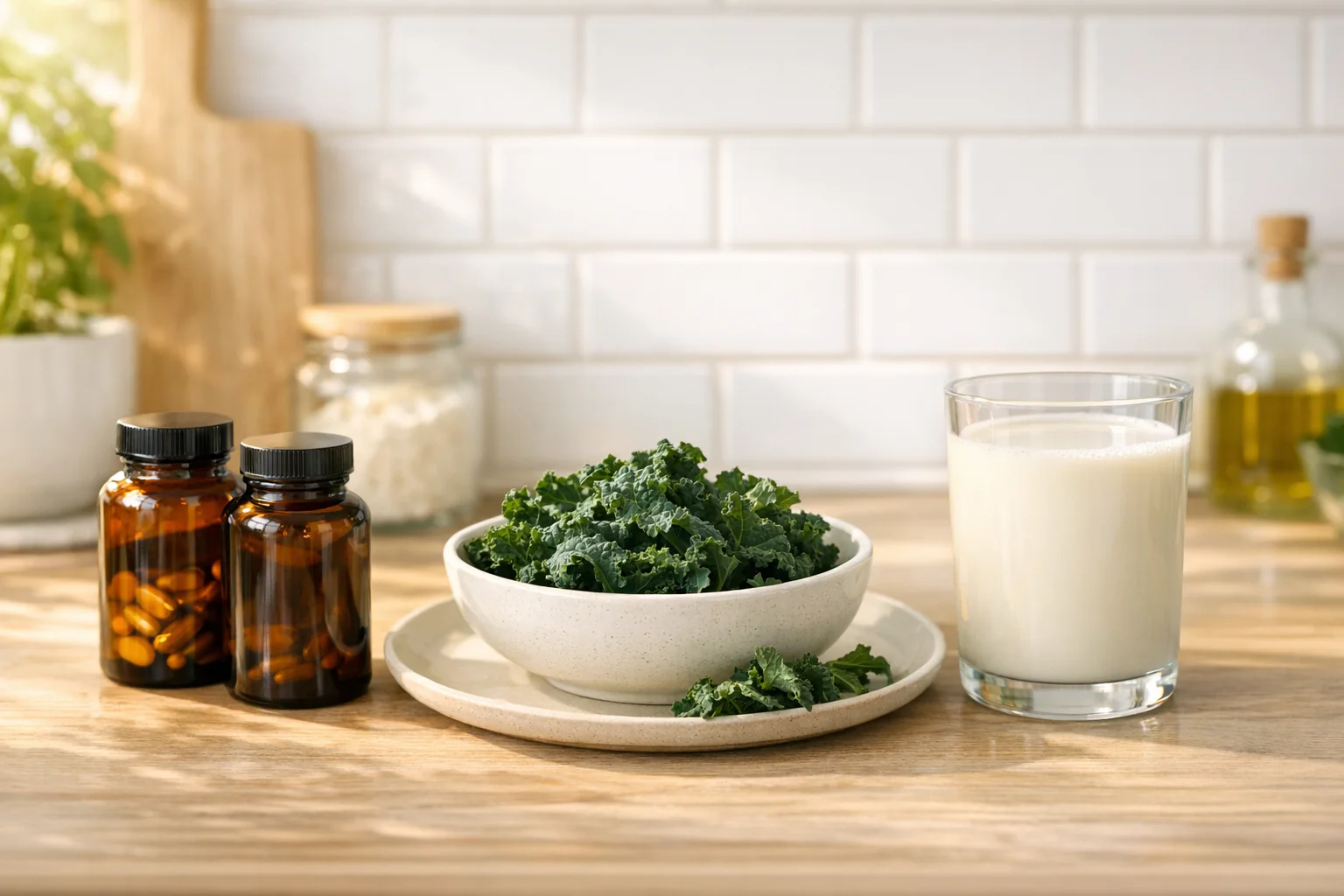
The D3 + K2 Synergy: How These Nutrients Work Together
The relationship between vitamins D3 and K2 illustrates one of nutrition’s most elegant synergies. D3 (cholecalciferol) increases the absorption and mobilization of calcium from your digestive tract, while K2 directs it specifically to bone and away from arteries through osteocalcin and MGP activation. Without adequate K2, high D3 can paradoxically increase arterial calcification while bones remain weak. All three—D3, K2, and calcium—work synergistically, with D3 mobilizing calcium, K2 directing it, and calcium as the raw material.
For plant-based eaters, D3 supplementation is already commonly recommended since plant foods contain negligible D3 and sun exposure is often insufficient. Adding K2 (MK-7, 90-180 μg daily) completes the trio and amplifies bone protection. Take with a fat-containing meal for optimal absorption since both are fat-soluble vitamins requiring dietary fat. Research shows no established harm from higher K2 intakes since K2 isn’t stored in the body like vitamins A and E, so the higher end (180 μg) is reasonable if you’re over 50 or with family history of bone loss or cardiovascular disease.