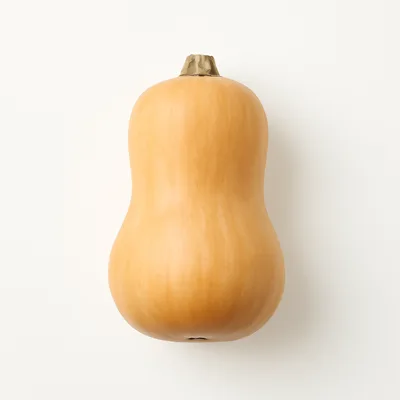
Vegetables
Squash, winter, all varieties, raw
Per 100 g
- Calories
- 34 kcal
- Protein
- 0.95 g
- Fiber
- 1.5 g
- Fat
- 0.13 g
Low fat 3% of its calories come from fat. Our scale
All nutrients
Per 100 g of squash, winter, all varieties, raw. % Daily Value is for an adult, US FDA values.
Macronutrients
| Nutrient | Per 100 g | % DV |
|---|---|---|
| Carbohydrates | 8.6 g | 3% |
| Protein | 0.95 g | 2% |
| Fat | 0.13 g | 0% |
| Water | 90 g |
Carbohydrates
| Nutrient | Per 100 g | % DV |
|---|---|---|
| Fiber | 1.5 g | 5% |
| Sugars | 2.2 g |
Essential amino acids
| Nutrient | Per 100 g |
|---|---|
| Histidine | 0.03 g |
| Isoleucine | 0.06 g |
| Leucine | 0.08 g |
| Lysine | 0.05 g |
| Methionine | 0.02 g |
| Phenylalanine | 0.06 g |
| Threonine | 0.04 g |
| Tryptophan | 0.02 g |
| Valine | 0.06 g |
Fats
| Nutrient | Per 100 g | % DV |
|---|---|---|
| Saturated fat | 0.03 g | 0% |
| Monounsaturated fat | 0.01 g | |
| Polyunsaturated fat | 0.06 g | |
| Omega 3 | 0.04 g | |
| Omega 6 | 0.02 g | |
| Trans fat | 0 g | |
| Cholesterol | 0 mg | 0% |
Vitamins
| Nutrient | Per 100 g | % DV |
|---|---|---|
| Vitamin A (RAE) | 68 µg | 8% |
| Vitamin C | 12 mg | 14% |
| Vitamin D | 0 µg | 0% |
| Vitamin E | 0.12 mg | 1% |
| Vitamin K1 | 1.1 µg | 1% |
| Thiamin (B1) | 0.03 mg | 3% |
| Riboflavin (B2) | 0.06 mg | 5% |
| Niacin (B3) | 0.5 mg | 3% |
| Pantothenic acid (B5) | 0.19 mg | 4% |
| Vitamin B6 | 0.16 mg | 9% |
| Folate (DFE) | 24 µg | 6% |
| Vitamin B12 | 0 µg | 0% |
Linked nutrients open a table that ranks plant foods by that nutrient.
Portion weights
| Portion | Weight | Calories |
|---|---|---|
| 1 cup, cubes | 116 g | 39 kcal |
How we label fat
Our own scale, stricter than official labels: a food with less than 10% of its calories from fat is labelled Low fat, 10% to under 20% Medium fat, 20% or more High fat. The label describes how the food's calories are made up; official US and UK labels use other limits.
More vegetables
 Squash, winter, butternut, raw
- Squash, winter, hubbard, raw
- Squash, winter, spaghetti, raw
 Squash, zucchini, baby, raw
 Sweet potato leaves, raw
 Sweet potato, raw, unprepared
 Taro leaves, raw
 Taro, raw
All vegetables · All ingredients
Source
USDA FoodData Central, SR Legacy (April 2018): Squash, winter, all varieties, raw, FDC ID 170489. Daily Values: US FDA, 21 CFR 101.9.